


Page 6 - Thinking_the_Unthinkable_Article_for_IBS
P. 6
The rest of the paper sets out to explain what L&D team at ACC
                  Figure 6: Scenario Planning in Perspective
                                                                    Concrete has so far done to help our middle managers develop
                                                                    their skill around using these tools.

                                                                    At L&D  we  began with the axiomatic  understanding that, as
                                                                    time goes on, the range of possible future outcomes becomes
                                                                    greater – that is there is greater uncertainty about will happen.


                                                                    Peripheral Vision: Being Focused versus being
                                                                    Alert

     To drive this workshop successfully it was important for L&D to measure how ACC Concrete as an organization was equipped to anticipate the future.
     The challenge here was subjective in nature, since the objective was to measure the importance managers gave to Peripheral Vision.

         1.  It was important to assess to what extent each individual manager was alert and perceived the periphery of their respective business domains
             at regular intervals.
         2.  In cases where the individuals did  have a
             sufficiently  developed peripheral vision it  was
             necessary to understand to what extent they were
             able to identify weak signals within their periphery.
         3.  Finally,  it was important to  understand how
             accurately the individual could articulate the
             impact of the weak signal  in a future business
             scenario

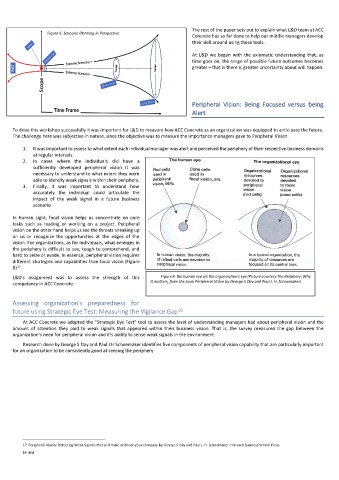
     In human sight,  focal vision helps us concentrate on core
     tasks  such as  reading or working on a project. Peripheral
     vision on the other hand helps us see the threats sneaking up
     on us or recognize the opportunities at  the  edges of the
     vision. For organizations, as for individuals, what emerges in
     the periphery is difficult to see, tough to comprehend, and
     hard to seize or evade. In essence, peripheral vision requires
     different strategies and capabilities than focal vision (Figure
     8) .
       17

     L&D’s assignment was to assess the strength of this   Figure 8: the human eye v/s the organization’s eye (Picture courtesy The Periphery: Why
     competency in ACC Concrete.                      it matters, from the book Peripheral Vision by George S Day and Paul J. H. Schoemaker)


     Assessing organization’s preparedness for
                                                                18
     future using Strategic Eye Test: Measuring the Vigilance Gap
         At ACC Concrete we adopted the “Strategic Eye Test” tool to assess the level of understanding managers had about peripheral vision and the
     amount of attention  they paid to weak signals that appeared within their business vision.  That is, the survey measured the gap between the
     organization’s need for peripheral vision and it’s ability to sense weak signals in the environment.

         Research done by George S Day and Paul J H Schoemaker identifies five components of peripheral vision capability that are particularly important
     for an organization to be consistently good at sensing the periphery


         17 Peripheral Vision: Detecting Weak Signals that will make or break your company by George S Day and Paul J. H. Schoemaker. Harvard Business School Press
         18 ibid

