


Page 3 - Thinking_the_Unthinkable_Article_for_IBS
P. 3
Forecasting  techniques  like
     qualitative techniques,  time
     series analysis and projection,
     causal models, econometric
     model, X 11  models  and other
     similar models  are very useful
     when there  are  established
     cause   –   and   –   effect
     relationships   between  the
     parameters   and   explicit
     correlations  between past and
     present data points.  However,
     significant changes  like new
     products,  new  competitive
     strategies and so forth diminish
     the similarity of past and future.
     Their  short-term  impact may
     not be much visible but in the
     long term they can alter overall
     patterns and in such  cases  –
     when the forecast has to be
     over a reasonably longer time
     horizon  –  many of these
     forecasting techniques do not
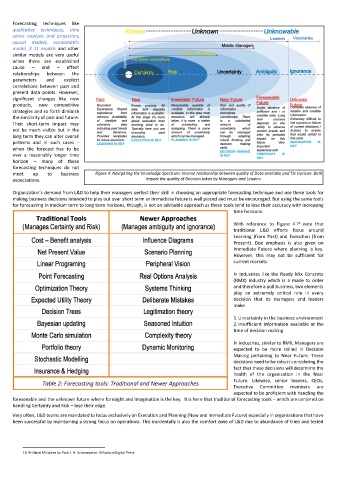
     meet    up   to   business   Figure 4: Navigating the Knowledge Spectrum: Inverse relationship between quality of Data available and Tie Horizon: Both
     expectations.                                  impact the quality of Decision taken by Managers and Leaders

     Organization’s demand from L&D to help their managers perfect their skill in choosing an appropriate forecasting technique and use these tools for
     making business decisions intended to play out over short term or immediate future is well placed and must be encouraged. But using the same tools
     for forecasting in medium term to long term horizons, though, is not an advisable approach as these tools tend to lose their accuracy with increasing
                                                                                   time horizons.

                                                                                   With reference to Figure 4  10   note that
                                                                                   traditional L&D efforts  focus around
                                                                                   Learning (from Past) and Execution (from
                                                                                   Present). Due emphasis is also given on
                                                                                   Immediate Future where planning is key.
                                                                                   However,  this may not be sufficient for
                                                                                   current markets.

                                                                                   In  industries like the  Ready Mix  Concrete
                                                                                   (RMX) industry  which is a made to order
                                                                                   and therefore a pull business, two elements
                                                                                   play an extremely critical  role in every
                                                                                   decision that its managers and leaders
                                                                                   make

                                                                                   1. Uncertainty in the business environment
                                                                                   2. Insufficient information  available  at the
                                                                                   time of decision making

                                                                                   In industries, similar to RMX, Managers are
                                                                                   expected to be  more  skilled in Decision
                                                                                   Making  pertaining to Near Future.  These
                                                                                   decisions need to be robust considering the
                                                                                   fact that these decisions will determine the
                                                                                   health of the organization in the  Near
                                                                                   Future. Likewise, senior leaders, CEOs,
                                                                                   Executive  Committee  members  are
                                                                                   expected to be proficient with handling the
     foreseeable and the unknown future where foresight and imagination is the key.  It is here that traditional forecasting tools – which are centered on
     handling Certainty and Risk – lose their edge.

     Very often, L&D teams are mandated to focus exclusively on Execution and Planning (Now and Immediate Future) especially in organizations that have
     been successful by maintaining a strong focus on operations. This incidentally is also the comfort zone of L&D due to abundance of tried and tested


         10 Brilliant Mistakes by Paul J. H. Schoemaker. Wharton Digital Press

