


Page 5 - Thinking_the_Unthinkable_Article_for_IBS
P. 5
6.  A comprehensive methodology for evaluating the impact of the learning initiatives must be in place right from the start. Note that the
             learning initiatives are designed to address distant and future events. Therefore, it could be difficult to demonstrate and assess the outcome
             of the workshop in the short run. Therefore, to get senior management’s buy in for these learning initiatives, it is important to have in place
             important yardsticks which can be used to gauge the effectiveness of the workshop from time to time. A valuable way of measuring the
             learning initiatives effectiveness is by measuring change in “Organization’s Perception”


     ACC Concrete L&D team’s approach for a future ready business: Developing Foresight - A choice beyond the
     obvious

     The RMX business of ACC Cement, known as ACC Concrete
     has been a pioneer in the Ready  Mix Concrete Industry
     since 1994. Over the decades it has successfully occupied a
     very strong space in the customer’s mind when it comes to
     delivering value. In the past few years the Concrete market
     has seen rapid and  rampant  commoditization.  In this
     environment, ACC Concrete is continuously challenged to
     innovate ways to stay ahead of the market by driving
     change rather than by responding to change.  The
     leadership team correctly believed  that to stay ahead of
     competition it was important  that middle level and
     frontline leaders be able  to predict the future with
     reasonable accuracy.

     As we explored new ways of developing foresight as a
     competency across all functions in the Mid-level as well as
     Tenured Leadership we identified two important  tools
     around which we designed our learning initiatives:

         1.  Developing Peripheral Vision:
                Specifically look for those things which might
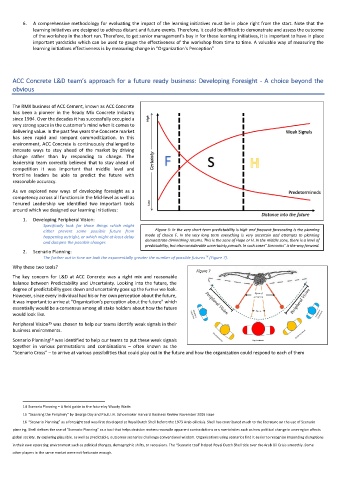
                either prevent some possible future from   Figure 5: In the very short term predictability is high and frequent forecasting is the planning
                happening outright, or which might at least delay   mode  of  choice  F. In the very long term everything is very  uncertain and attempts to planning
                and dampen the possible changes     demonstrate diminishing returns. This is the zone of Hope or H. In the middle zone, there is a level of
                                                    predictability, but also considerable uncertainty prevails. In such cases” Scenarios” is the way forward.
         2.  Scenario Planning:
                                                                         14
                The further out in time we look the exponentially greater the number of possible futures  (Figure 7).

     Why these two tools?
                                                                      Figure 7
     The key concern for L&D at  ACC Concrete was a  right mix and reasonable
     balance between Predictability and Uncertainty. Looking into the future, the
     degree of predictability goes down and uncertainty goes up the further we look.
     However, since every individual had his or her own perception about the future,
     it was important to arrive at “Organization’s perception about the future” which
     essentially would be a consensus among all stake holders about how the future
     would look like.

     Peripheral Vision  was chosen to help our teams identify weak signals in their
                  15
     business environments.

     Scenario Planning  was identified to help our teams to put these weak signals
                   16
     together in various permutations and combinations  –  often known as the
     “Scenario Cross” – to arrive at various possibilities that could play out in the future and how the organization could respond to each of them


         14 Scenario Planning – A field guide to the future by Woody Wade.

         15 “Scanning the Periphery” by George Day and Paul J. H. Schoemaker Harvard Business Review November 2005 issue

         16 “Scenario Planning” as a foresight tool was first developed at Royal Dutch Shell before the 1973 Arab oil crisis. Shell has contributed much to the literature on the use of Scenario

     planning. Shell defines the use of “Scenario Planning” as a tool that helps decision makers reconcile apparent contradictions or uncertainties such as how political change in one region affects
     global society. By exploring plausible, as well as predictable, outcomes scenarios challenge conventional wisdom. Organizations using scenarios find it easier to recognize impending disruptions
     in their own operating environment such as political changes, demographic shifts, or recessions. The “Scenario tool” helped Royal Dutch Shell tide over the Arab Oil Crisis smoothly. Some
     other players in the same market were not fortunate enough.

