


Page 2 - Thinking_the_Unthinkable_Article_for_IBS
P. 2
But before we deep dive into the L&D perspective, I would like to draw the reader’s attention to an example Clayton Christensen describes in his
                                                              4
     book The Innovator’s Dilemma which is very significant to our discussion here .

         Sears Roebuck, was regarded for decades as one of the most astutely managed retailers in the world. At its zenith Sears accounted for more than
     2 percent of all retail sales in the United States. It pioneered several innovations critical to the success of today’s most admired retailers like supply
     chain management, store brands, credit card sales et cetera. The esteem in which Sear’s management was held shows in this 1964 excerpt from
     Fortune: “How did Sears do it? In a way, the most arresting aspect of its story is that there is no gimmick. Sears opened no big bag of tricks, shot of no
     skyrockets. Instead it looked as though everybody in its organization simply did the right thing, easily and naturally. And their cumulative effect was to
     create an extraordinary powerhouse of a company”
                                           5

         Though Sears revolutionized the retailing market of its day, no one speaks about Sears that way today. Amidst the retailing boom, credit card
     sales, catalogue marketing and now online sales, Sears
     has been driven out of its own forte, out of the very
     market it once pioneered. But most significantly – and
     this is the point important for our discussion here – Sears
     received its accolades at exactly the time – in the mid
     1960’s  –  when  it was  ignoring the rise of Discount
     Retailing and home centers. Sears was praised as one of
     the best managed companies in the world at the very
     time it let Visa and MasterCard usurp the enormous lead
                                              6
     it had established in the use of credit cards in retailing.
     Likewise, Xerox dominated the plain paper photocopiers
                      7
     markets  in the 1960s . By 1961 Xerox had become a
     fortune 500 company and by 1968 it achieved $1 Billion
     in sales, the fastest organization to reach that landmark
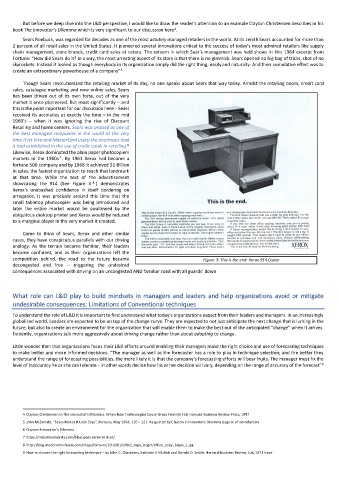
     at that time.  While  the text of the advertisement
     showcasing the 914  (See Figure  3 )  demonstrates
                                  8
     Xerox’s unabashed confidence  in itself  bordering on
     arrogance, it was precisely around this time that the
     small tabletop photocopier  was being introduced and
     later the entire  market would be swallowed by  the
     ubiquitous desktop printer and Xerox would be reduced
     to a marginal player in the very market it created.

         Come to think of Sears, Xerox and other similar
     cases, they have conspicuous parallels with our driving
     analogy. As the terrain became familiar, their  leaders
     became  confident,  and  as  their  organizations left the
     competition  behind, the road to the future became                 Figure 3: This is the end: Xerox 914 Copier
     decongested and free  –  triggering  the  undesired
     consequences associated with driving on an uncongested AND familiar road with all guards’ down


     What role can L&D play to build mindsets in managers and leaders and help organizations avoid or mitigate
     undesirable consequences: Limitations of Conventional techniques
     To understand the role of L&D it is important to first understand what today’s organizations expect from their leaders and managers. In an increasingly
     globalized world, Leaders are expected to be on top of the change curve. They are expected to not just anticipate the next change that is lurking in the
     future, but also to create an environment for the organization that will enable them to make the best out of the anticipated “change” when it arrives.
     Evidently, organizations talk more aggressively about driving change rather than about adapting to change.

     Little wonder then that organizations focus their L&D efforts around enabling their managers make the right choice and use of forecasting techniques
     to make better and more informed decisions. “The manager as well as the forecaster has a role to play in technique selection; and the better they
     understand the range of forecasting possibilities, the more likely it is that the company’s forecasting efforts will bear fruits. The manager must fix the
     level of inaccuracy he or she can tolerate – in other words decide how his or her decision will vary, depending on the range of accuracy of the forecast”
                                                                                                                  9


         4 Clayton Christensen in The Innovator’s Dilemma: When New Technologies Cause Great Firms to Fail, Harvard Business Review Press, 1997
         5 John McDonald, “Sears Makes It Look Easy”, Fortune, May 1964, 120 – 121. As quoted by Clayton in Innovators Dilemma page ix of Introduction

         6 Clayton: Innovator’s Dilemma

         7 https://industryanalysts.com/blast-past-xerox-914-ad/


         8 http://blog.modernmechanix.com/mags/Fortune/10-1961/office_copy_begin/office_copy_begin_1.jpg

         9 How to choose the right forecasting technique – by John C. Chambers, Satinder K Mullick and Donald D. Smith. Harvard Business Review, July 1971 issue

