


Page 8 - Thinking_the_Unthinkable_Article_for_IBS
P. 8
1.  To create a better understanding and importance of ‘Peripheral Vision” and develop an attitude of “Alertness” to weak signals in the
                immediate business environment
             2.  Identify and evaluate relevant “Weak Signals” in the environment that could impact business environment in the immediate future and
                long run (Figure 10)
             3.  Visualize scenarios where two or more weak signals could come to pass and what consequences – positive or negative – it could have
                for the organization
             4.  Develop a model for revisiting the scenarios identified during the workshop at regular intervals for a specified period of time

     Executing the workshop – challenging the obvious

         Two alternative prototypes  were designed as an approach to conduct the learning workshop.
                             20

         The first prototype approached the workshop had an “Outside” approach. That is from an overall assessment and benchmarking point of view –
     defining where the organization currently stood and where it would want to go in the next two years. Identify Emerging Issues and create Scenarios
     from with various permutations and combinations of emerging issues

         The second prototype approached the workshop from the “Inside”, helping individuals identify their thinking biases through case studies. Observe
     and analyze historical data to segregate information into predetermined categories of importance and analyze possible scenarios when events with
     varying level of importance are brought together

     The first approach, “Thinking the Unthinkable” was selected for conducting the three-day learning workshop.

     Key Outcomes from the workshop


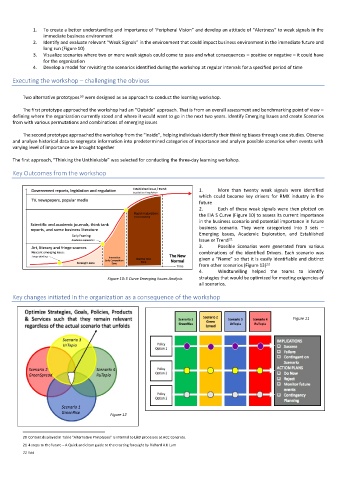
                                                                       1.     More than  twenty weak signals were identified
                                                                       which could become key drivers for RMX industry in the
                                                                       future
                                                                       2.     Each of these weak signals were then plotted on
                                                                       the EIA S Curve (Figure 10) to assess its current importance
                                                                       in the business scenario and potential importance in future
                                                                       business scenario. They were categorized into 3 sets  –
                                                                       Emerging Issues, Academic Exploration, and Established
                                                                                 21
                                                                       Issue or Trend
                                                                       3.     Possible Scenarios  were generated from various
                                                                       combinations of the identified Drivers. Each scenario was
                                                                       given a “Name” so that it is easily identifiable and distinct
                                                                                               22
                                                                       from other scenarios (Figure 13)
                                                                       4.     Windtunelling helped the teams to  identify
                                       Figure 10: S Curve Emerging Issues Analysis   strategies that would be optimized for meeting exigencies of
                                                                       all scenarios.
     Key changes initiated in the organization as a consequence of the workshop


                                                                                                        Figure 11


                                        Figure 12


         20 Content displayed in Table “Alternative Prototypes” is internal to L&D processes at ACC Concrete.
         21 4 steps to the future – A Quick and clean guide to the creating foresight by Richard A K Lum


         22 Ibid

