


Page 1 - Thinking_the_Unthinkable_Article_for_IBS
P. 1
Sahishnu Majumdar


     Thinking the Unthinkable The role of L&D in creating Future Ready organizations

           I enjoy driving. Whether busy roads or freeways, the experience is always
       exhilarating and educative. As an L&D Manager, it gives me ample opportunity to
       observe my own behavior  and learn more about my  own  responses, while I
       control the wheels. One important observation that I have recently begun to have
       is that I tend  to make more mistakes in two cases: on familiar routes and on
       uncongested roads. Conversely, I tend to make far fewer mistakes when driving
       on unfamiliar routes or congested roads especially when I am pushing through a
       traffic jam. The second scenario puts me in a rather uncomfortable zone. So, does
       that mean a  comfortable environment  as described in the first scenario  –
       (uncongested  roads) or a confident terrain (familiar routes)  make me more
       relaxed, lower my guard and take  everything in my environment for granted?
       Flipping this question  over,  do I become more  alert, more attentive, more
       conscious of my environment when I am traversing an unfamiliar territory or
       when I am in an uncomfortable zone – traffic jams for sure is the last place I want
                 1
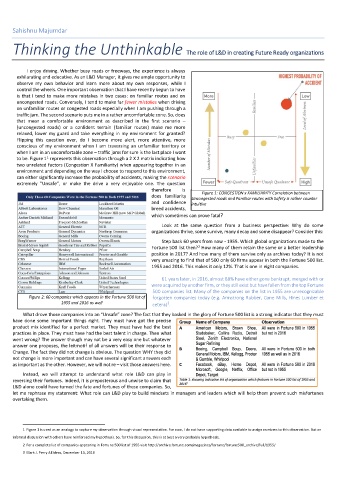
       to be. Figure 1  represents this observation through a 2 X 2 matrix indicating how
       two unrelated factors (Congestion X Familiarity) when appearing together in an
       environment and depending on the way I choose to respond to this environment,
       can either significantly increase the probability of accidents, making the scenario
       extremely “Unsafe”, or make  the drive  a very enjoyable  one.  The question
                                                      therefore  is
                                                                        Figure 1: CONGESTION x FAMILIARITY Correlation between
                                                      does familiarity   Uncongested roads and Familiar routes with Safety is rather counter
                                                      and confidence   intuitive
                                                      breed accidents,
                                                      which sometimes can prove fatal?

                                                          Look at the same  question from a  business perspective:  Why do some
                                                      organizations thrive, some survive, many decay and some disappear? Consider this:

                                                          Step back 60 years from now - 1955. Which global organizations made to the
                                                      Fortune 500 list then?  How many of them retain the same or a better leadership
                                                                       2
                                                      position in 2017? And how many of them survive only as archives today? It is not
                                                      very amazing to find that of 500 only 60 firms appear in both the Fortune 500 list.
                                                      1955 and 2016. This makes it only 12%. That is one in eight companies.

                                                          61 years later, in 2016, almost 88% have either gone bankrupt, merged with or
                                                      were acquired by another firm, or they still exist but have fallen from the top Fortune
                                                       500 companies list. Many of the companies on the list in 1955 are unrecognizable
           Figure 2: 60 companies which appears in the Fortune 500 list of   forgotten companies today (e.g. Armstrong Rubber, Cone Mills, Hines Lumber et
                       1955 and 2016 as well           cetera) .
                                                            3

         What drove those companies into an “Unsafe” zone? The fact that they basked in the glory of Fortune 500 list is a strong indicator that they must
     have done some important  things right.  They must have got the precise
     product mix identified for a perfect market. They must have had the best
     practices in place. They must have had the best talent in charge. Then what
     went wrong? The answer though may not be a very easy one but whatever
     answer one proposes, the leitmotif of all answers will be their response to
     Change. The fact they did not change is obvious. The question WHY they did
     not change is more important and can have several significant answers each
     as important as the other. However, we will not re – visit those answers here.

         Instead, we will  attempt to understand  what role L&D can play  in
     reversing their fortunes. Indeed, it is preposterous and unwise to claim that
     L&D alone could have turned the fate and fortunes of these companies. So,
     let me rephrase my statement: What role can L&D play to build mindsets in managers and leaders which will help them prevent such misfortunes
     overtaking them.


         1 Figure 1 is used as an analogy to capture my observation through visual representation. For now, I do not have supporting data available to assign numbers to this observation. But an
     informal discussion with others have reinforced my hypothesis. So, for this discussion, this is at best a very probable hypothesis.

         2 For a complete list of companies appearing in Fortune 500 list of 1955 visit http://archive.fortune.com/magazines/fortune/fortune500_archive/full/1955/

         3 Mark J. Perry AEIdeas, December 13, 2016

