


Page 4 - Managing_Conflict_Sample_Report
P. 4
Report 4


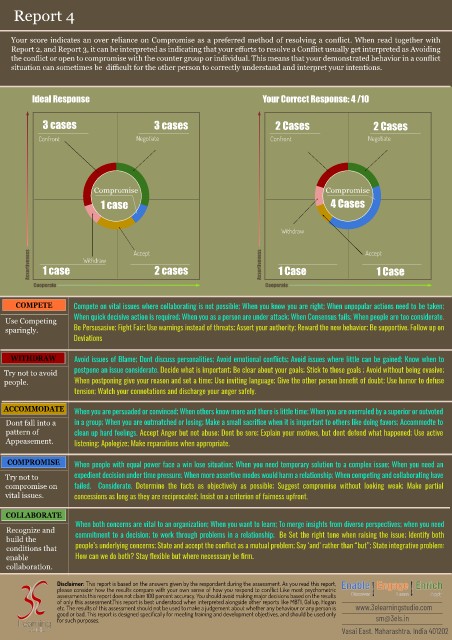
    Your score indicates an over reliance on Compromise as a preferred method of resolving a conflict. When read together with
    Report 2, and Report 3, it can be interpreted as indicating that your efforts to resolve a Conflict usually get interpreted as Avoiding
    the conflict or open to compromise with the counter group or individual. This means that your demonstrated behavior in a conflict
    situation can sometimes be difficult for the other person to correctly understand and interpret your intentions.


          Ideal Response                                              Your Correct Response: 4 /10


            3 cases                       3 cases                         2 Cases                  2 Cases
           Confront                  Negotiate                          Confront                  Negotiate


                          Compromise                                                   Compromise
                            1 case                                                      4 Cases


                                                                           Withdraw


         Assertiveness  1 case  Withdraw  Accept  2 cases             Assertiveness  1 Case      Accept

                                                                                                    1 Case
          Cooperate                                                    Cooperate


     COMPETE        Compete on vital issues where collaborating is not possible; When you know you are right; When unpopular actions need to be taken;
                    When quick decisive action is required; When you as a person are under attack; When Consensus fails; When people are too considerate.
  Use Competing
  sparingly.        Be Persusasive; Fight Fair; Use warnings instead of threats; Assert your authority; Reward the new behavior; Be supportive. Follow up on
                    Deviations

    WITHDRAW         Avoid issues of Blame; Dont discuss personalities; Avoid emotional conflicts; Avoid issues where little can be gained; Know when to
                     postpone an issue considerate. Decide what is important; Be clear about your goals; Stick to those goals ; Avoid without being evasive;
  Try not to avoid
  people.            When postponing give your reason and set a time; Use inviting language; Give the other person benefit of doubt; Use humor to defuse
                     tension; Watch your connotations and discharge your anger safely.


  ACCOMMODATE        When you are persuaded or convinced; When others know more and there is little time; When you are overruled by a superior or outvoted
   Dont fall into a  in a group; When you are outmatched or losing; Make a small sacrifice when it is important to others like doing favors; Accommodte to
   pattern of        clean up hard feelings. Accept Anger but not abuse; Dont be sore; Explain your motives, but dont defend what happened; Use active
   Appeasement.      listening; Apologize; Make reparations when appropriate.


   COMPROMISE        When people with equal power face a win lose situation; When you need temporary solution to a complex issue; When you need an
  Try not to         expedient decision under time pressure; When more assertive modes would harm a relationship; When competing and collaborating have
  compromise on      failed. Considerate. Determine the facts as objectively as possible; Suggest compromise without looking weak; Make partial
  vital issues.      concessions as long as they are reciprocated; Insist on a criterion of fairness upfront.

   COLLABORATE
                     When both concerns are vital to an organization; When you want to learn; To merge insights from diverse perspectives; when you need
   Recognize and     commitment to a decision; to work through problems in a relationship; Be Set the right tone when raising the issue; Identify both
   build the         people’s underlying concerns; State and accept the conflict as a mutual problem; Say ‘and’ rather than “but”; State integrative problem:
   conditions that
   enable            How can we do both? Stay flexible but where necesssary be firm.
   collaboration.
                Disclaimer: This report is based on the answers given by the respondent during the assessment. As you read this report,
                please consider how the results compare with your own sense of how you respond to conflict Like most psychometric
                assessments this report does not claim 100 percent accuracy. You should avoid making major decisions based on the results
                of only this assessment.This report is best understood when interpreted alongside other reports like MBTI, Gallup, Hogan
                etc. The results of this assessment should not be used to make a judgement about whether any behaviour or any person is  www.3elearningstudio.com
                good or bad. This report is designed specifically for meeting training and development objectives, and should be used only
                for such purposes.                                                                  sm@3els.in
                                                                                           Vasai East. Maharashtra. India 401202

