


Page 3 - Managing_Conflict_Sample_Report
P. 3
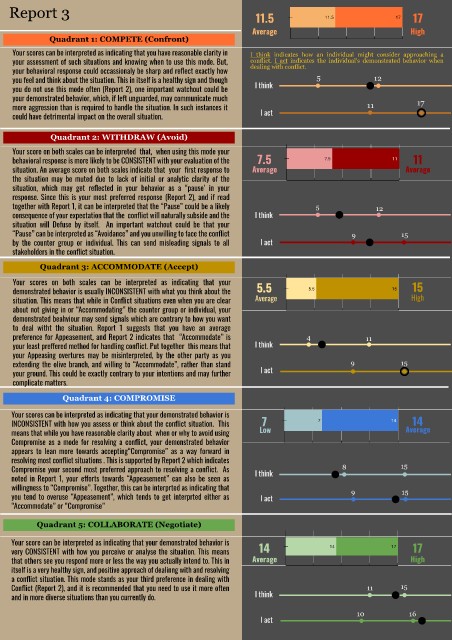
Report 3                                                         11.5                                      17

                                                                   Average                                   High
              Quadrant 1: COMPETE (Confront)
    Your scores can be interpreted as indicating that you have reasonable clarity in  I think indicates how an individual might consider approaching a
    your assessment of such situations and knowing when to use this mode. But,  conflict. I act indicates the individual’s demonstrated behavior when
    your behavioral response could occassionaly be sharp and reflect exactly how  dealing with conflict.
    you feel and think about the situation. This in itself is a healthy sign and though  5          12
    you do not use this mode often (Report 2), one important watchout could be  I think
    your demonstrated behavior, which, if left unguarded, may communicate much
    more aggression than is required to handle the situation. In such instances it                11           17
    could have detrimental impact on the overall situation.           I act


              Quadrant 2: WITHDRAW (Avoid)
    Your score on both scales can be interpreted that, when using this mode your
    behavioral response is more likely to be CONSISTENT with your evaluation of the  7.5                      11
    situation. An average score on both scales indicate that your first response to  Average                Average
    the situation may be muted due to lack of initial or analytic clarity of the
    situation, which may get reflected in your behavior as a “pause’ in your
    response. Since this is your most preferred response (Report 2), and if read
    together with Report 1, it can be interpreted that the “Pause” could be a likely  5             12
    consequence of your expectation that the conflict will naturally subside and the  I think
    situation will Defuse by itself. An important watchout could be that your
    “Pause” can be interpreted as “Avoidance” and you unwilling to face the conflict          9            15
    by the counter group or individual. This can send misleading signals to all  I act
    stakeholders in the conflict situation.

            Quadrant 3: ACCOMMODATE (Accept)
    Your scores on both scales can be interpreted as indicating that your                                     15
    demonstrated behavior is usually INCONSISTENT with what you think about the  5.5
    situation. This means that while in Conflict situations even when you are clear  Average                 High
    about not giving in or “Accommodating” the counter group or individual, your
    demonstrated beahviour may send signals which are contrary to how you want
    to deal witht the situation. Report 1 suggests that you have an average
    preference for Appeasement, and Report 2 indicates that “Accommodate” is      4              11
    your least preffered method for handling conflict. Put together this means that  I think
    your Appeasing overtures may be misinterpreted, by the other party as you
    extending the olive branch, and willing to “Accommodate”, rather than stand              9             15
    your ground. This could be exactly contrary to your intentions and may further  I act
    complicate matters.

                  Quadrant 4: COMPROMISE
    Your scores can be interpreted as indicating that your demonstrated behavior is
    INCONSISTENT with how you assess or think about the conflict situation. This  7                           14
    means that while you have reasonable clarity about when or why to avoid using  Low                      Average
    Compromise as a mode for resolving a conflict, your demonstrated behavior
    appears to lean more towards accepting“Compromise” as a way forward in
    resolving most conflict situations . This is supported by Report 2 which indicates
    Compromise your second most preferred approach to resolving a conflict. As  I think    8               15
    noted in Report 1, your efforts towards “Appeasement” can also be seen as
    willingness to “Compromise”. Together, this can be interprted as indicating that
    you tend to overuse “Appeasement”, which tends to get interprted either as  I act        9             15
    “Accommodate” or “Compromise”


           Quadrant 5: COLLABORATE (Negotiate)
    Your score can be interpreted as indicating that your demonstrated behavior is
    very CONSISTENT with how you perceive or analyse the situation. This means  14                            17
    that others see you respond more or less the way you actually intend to. This in  Average                High
    itself is a very healthy sign, and positive approach of dealinng with and resolving
    a conflict situation. This mode stands as your third preference in dealing with
    Conflict (Report 2), and it is recommended that you need to use it more often                 11       15
    and in more diverse situations than you currently do.           I think


                                                                      I act                    10            16

