


Page 2 - Managing_Conflict_Sample_Report
P. 2
Report 2                                                             We can summarize this by describing a person’s
                                                                         behavior  along   two   basic   dimensions,
   Approach                                                              Assertiveness     and      Cooperativeness:

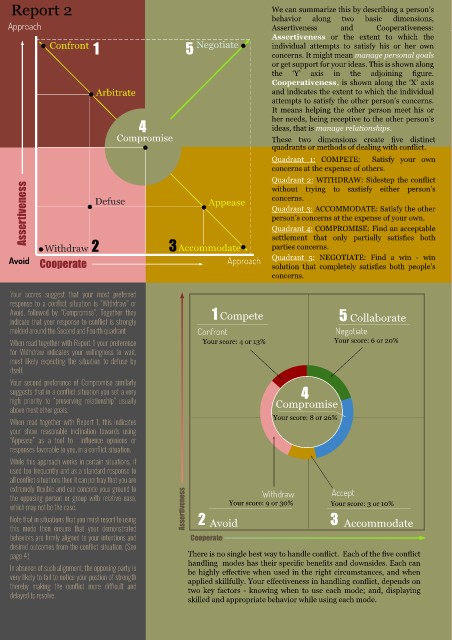
                                                                         Assertiveness or the extent to which the
              Confront    1                       5  Negotiate           individual attempts to satisfy his or her own
                                                                         concerns. It might mean manage personal goals
                                                                         or get support for your ideas. This is shown along
                                                                         the  ‘Y’  axis  in  the   adjoining  figure.
                                                                         Cooperativeness, is shown along the ‘X’ axis
                          Arbitrate                                      and indicates the extent to which the individual
                                                                         attempts to satisfy the other person’s concerns.
                                                                         It means helping the other person meet his or
                                                                         her needs, being receptive to the other person’s
                                      4                                  ideas, that is manage relationships.
                                Compromise                               These two dimensions create five distinct
                                                                         quadrants or methods of dealing with conflict.
                                                                         Quadrant 1: COMPETE:      Satisfy your own
                                                                         concerns at the expense of others.
                                                                         Quadrant 2: WITHDRAW: Sidestep the conflict
        Assertiveness     Defuse                        Appease          concerns.
                                                                                         to
                                                                                 trying
                                                                         without
                                                                                                            person’s
                                                                                                     either
                                                                                             sastisfy
                                                                         Quadrant 3: ACCOMMODATE: Satisfy the other
                                                                         person’s concerns at the expense of your own.
                                                                         Quadrant 4: COMPROMISE: Find an acceptable
             Withdraw 2
                                                                         parties concerns.
                                                                         Quadrant 5: NEGOTIATE: Find a win - win
                                                             Approach
   Avoid   Cooperate                          3  Accommodate             settlement that only partially satisfies both
                                                                         solution that completely satisfies both people’s
                                                                         concerns.
    Your scores suggest that your most preferred
    response to a conflict situation is “Withdraw” or
    Avoid, followed by “Compromise”. Together they       1  Compete                       5
    indicate that your response to conflict is strongly                                      Collaborate
    molded around the Second and Fourth quadrant     Confront                            Negotiate
    When read together with Report 1 your preference  Your score: 4 or 13%               Your score: 6 or 20%
    for Withdraw indicates your willingness to wait,
    most likely expecting the situation to defuse by
    itself.
    Your second preference of Compromise similarly
    suggests that in a conflict situation you set a very                        4
    high priority to “preserving relationship” usually                    Compromise
    above most other goals.
    When read together with Report 1, this indicates                     Your score: 8 or 26%
    your show reasonable inclination towards using
    “Appease” as a tool to  influence opinions or
    responses favorable to you, in a conflict situation.
    While this approach works in certain situations, if
    used too frequently and as a standard response to
    all conflict situations then it can portray that you are
    extremely flexible and can concede your ground to                                   Accept
    the opposing person or group with relative ease,                  Withdraw
    which may not be the case.                    Assertiveness  Your score: 9 or 30%   Your score: 3 or 10%
    Note that in situations that you must resort to using  2                            3
    this mode then ensure that your demonstrated        Avoid                               Accommodate
    behaviors are firmly aligned to your intentions and  Cooperate
    desired outcomes from the conflict situation. (See
    page 4)                                        There is no single best way to handle conflict. Each of the five conflict
    In absence of such alignment, the opposing party is  handling modes has their specific benefits and downsides. Each can
    very likely to fail to notice your postion of strength  be highly effective when used in the right circumstances, and when
    thereby making the conflict more difficult and  applied skillfully. Your effectiveness in handling conflict, depends on
    delayed to resolve.                            two key factors - knowing when to use each mode; and, displaying
                                                   skilled and appropriate behavior while using each mode.

