


Page 1 - Managing_Conflict_Sample_Report
P. 1
Sample Report                                                                     Date: 02 June 2020


    Conflict is simply the condition, in which people’s concerns - the things they care about most - appear to be incompatible. Surveys
    show that managers spend about a quarter of their time handling conflicts In dealing with a conflict the general orientation that
    individuals or groups display are either “Avoiding the Conflict” or “Approaching the Conflict”. Avoidance aims at avoiding or
    postponing conflict and is based out of fear. Though, Approach style is based out of hope, it can take the form of Understanding
    or can take the form of Aggression.
                        Approach Styles                                          Avoidance Styles
                                                                                  Avoidance Styles
    Confront: This indicates fighting out an issue to get a solution in one’s  Accommodate: Extreme avoidance or being fatalistic, where conflict is
    favor.                                                    seen as a part of reality with the assumption that it must be lived with.
    Arbitration: Here the objective is to bring in a third party to assess the  Withdrawal: Here the objective is to get away or escape the conflict
    situation objectively and arrive at a solution acceptable to both parties.  situation.
    Compromise: This is a process of sharing in the gain without resolving the  Defusion: Here the objective is to hope that, with the passage of time,
    conflict and is usually done through bargaining.          emotions will settle and the conflict will wither away.
    Negotiation: In this approach both parties jointly collaborate on the  Appeasement: Here the objective is to appeal to positive and feel good
    situation and explore its solution.                       emotions to buy temporary peace.


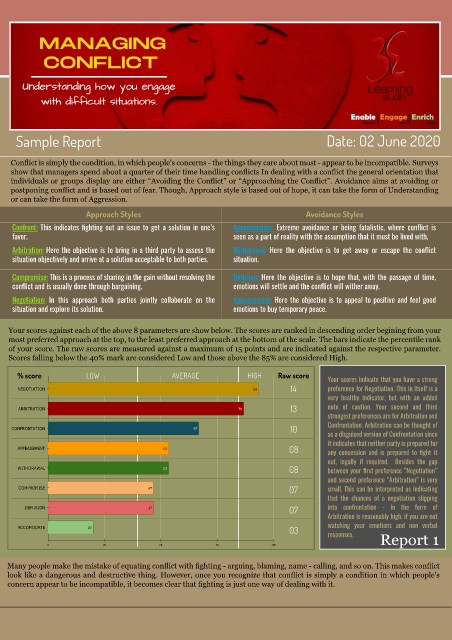
   Your scores against each of the above 8 parameters are show below. The scores are ranked in descending order begining from your
   most preferred approach at the top, to the least preferred approach at the bottom of the scale. The bars indicate the percentile rank
   of your score. The raw scores are measured against a maximum of 15 points and are indicated against the respective parameter.
   Scores falling below the 40% mark are considered Low and those above the 85% are considered High.

      % score           LOW                   AVERAGE             HIGH    Raw score    Your scores indicate that you have a strong
                                                                              14       preference for Negotiation. This in itself is a
                                                                                       very healthy indicator, but with an added
                                                                              13       note of caution. Your second and third
                                                                                       strongest preferences are for Arbitration and
                                                                              10       Confrontation. Arbitration can be thought of
                                                                                       as a disguised version of Confrontation since
                                                                                       it indicates that neither party is prepared for
                                                                             08        any concession and is prepared to fight it
                                                                                       out, legally if required. Besides the gap
                                                                             08        between your first preference “Negotiation”
                                                                                       and second preference “Arbitration” is very
                                                                             07        small. This can be interpreted as indicating
                                                                                       that the chances of a negotiation slipping
                                                                             07        into confrontation - in the form of
                                                                                       Arbitration is reasonably high, if you are not
                                                                             03        watching your emotions and non verbal
                                                                                       responses.
                                                                                                     Report 1


   Many people make the mistake of equating conflict with fighting - arguing, blaming, name - calling, and so on. This makes conflict
   look like a dangerous and destructive thing. However, once you recognize that conflict is simply a condition in which people’s
   concern appear to be incompatible, it becomes clear that fighting is just one way of dealing with it.

