


Page 2 - Locus_Of_Control_Sample_Report_Sample
P. 2
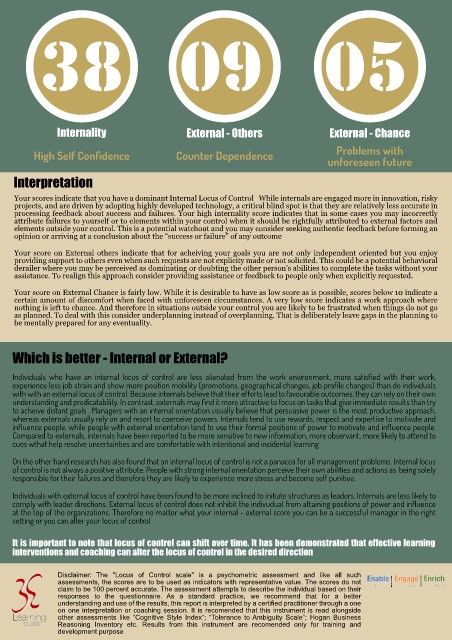
38 09 05


                Internality                       External - Others                     External - Chance

          High Self Confidence                 Counter Dependence                         Problems with
                                                                                       unforeseen future


     Interpretation

     Your scores indicate that you have a dominant Internal Locus of Control While internals are engaged more in innovation, risky
     projects, and are driven by adopting highly developed technology, a critical blind spot is that they are relatively less accurate in
     processing feedback about success and failures. Your high internality score indicates that in some cases you may incorrectly
     attribute failures to yourself or to elements within your control when it should be rightfully attributed to external factors and
     elements outside your control. This is a potential watchout and you may consider seeking authentic feedback before forming an
     opinion or arriving at a conclusion about the “success or failure” of any outcome

     Your score on External others indicate that for acheiving your goals you are not only independent oriented but you enjoy
     providing support to others even when such requests are not explicity made or not solicited. This could be a potential behavioral
     derailer where you may be perceived as dominating or doubting the other person’s abilities to complete the tasks without your
     assistance. To realign this approach consider providing assistance or feedback to people only when explicitly requested.

     Your score on External Chance is fairly low. While it is desirable to have as low score as is possible, scores below 10 indicate a
     certain amount of discomfort when faced with unforeseen circumstances. A very low score indicates a work approach where
     nothing is left to chance. And therefore in situations outside your control you are likely to be frustrated when things do not go
     as planned. To deal with this consider underplanning instead of overplanning. That is deliberately leave gaps in the planning to
     be mentally prepared for any eventuality.


    Which is better - Internal or External?

    Individuals who have an internal locus of control are less alienated from the work environment, more satisfied with their work,
    experience less job strain and show more position mobility (promotions, geographical changes, job profile changes) than do individuals
    with with an external locus of control. Because internals believe that their efforts lead to favourable outcomes, they can rely on their own
    understanding and predicatability. In contrast, externals may find it more attractive to focus on tasks that give immediate results than try
    to acheive distant goals . Managers with an internal orientation usually believe that persuasive power is the most productive approach,
    whereas externals usually rely on and resort to coerceive powers. Internals tend to use rewards, respect and expertise to motivate and
    influence people, while people with external orientation tend to use their formal positions of power to motivate and influence people.
    Compared to externals, internals have been reported to be more sensitive to new information, more observant, more likely to attend to
    cues wthat help resolve uncertainties and are comfortable with intentional and incidental learning

    On the other hand research has also found that an internal locus of control is not a panacea for all management problems. Internal locus
    of control is not always a positive attribute. People with strong internal orientation perceive their own abilities and actions as being solely
    responsible for their failures and therefore they are likely to experience more stress and become self punitive.
    Individuals with external locus of control have been found to be more inclined to initiate structures as leaders. Internals are less likely to
    comply with leader directions. External locus of control does not inhibit the indivudual from attaining positions of power and influence
    at the top of the organizations. Therefore no matter what your internal - external score you can be a successful manager in the right
    setting or you can alter your locus of control


    It is important to note that locus of control can shift over time. It has been demonstrated that effective learning
    interventions and coaching can alter the locus of control in the desired direction


                Disclaimer: The "Locus of Control scale" is a psychometric assessment and like all such
                assessments, the scores are to be used as indicators with representative value. The scores do not
                claim to be 100 percent accurate. The assessment attempts to describe the individual based on their
                responses to the questionnaire. As a standard practice, we recommend that for a better
                understanding and use of the results, this report is interpreted by a certified practitioner through a one
                on one interpretation or coaching session. It is recomended that this instrument is read alongside
                other assessments like “Cognitive Style Index”; “Tolerance to Ambiguity Scale”; Hogan Business
                Reasoning Inventory etc. Results from this instrument are recomended only for training and
                development purpose

