


Page 1 - Locus_Of_Control_Sample_Report_Sample
P. 1
Sample Report                                                                            Date: 2 June 2021
                                                                                                     nd


    What is the scale

     Locus of Control refers to the attitude people develop regarding the extent to which they are in control of their own destinies.
     When individuals receive information about the success or failure of their own actions, they differ in how they interpret that
     information. If individuals interpret that information as resulting from their own choices and actions, it is called an “Internal
     Locus of Control” - that is “I was the cause of success or failure of the change”. If they interpret the information as a product of
     outside forces, beyond their control it is called “External Locus of Control” - that is “Something or someone else caused the
     success or failure of the change”. Externality is further impacted by two distinct factors. The first factor is the perceived
     influence of powerful people. The second is the perceived influence of chance or luck.


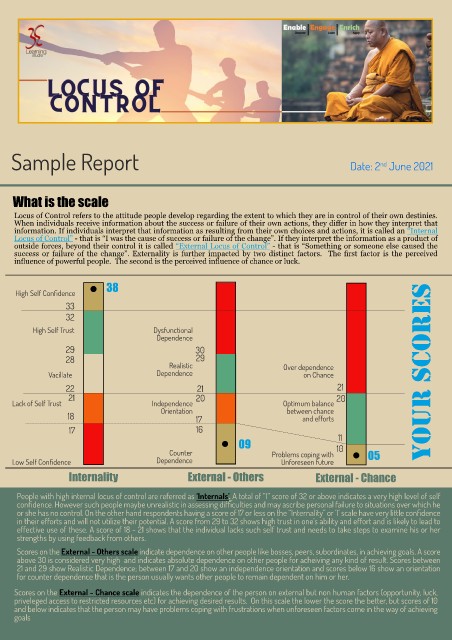
                             38
     High Self Confidence
                  33
                  32

          High Self Trust                Dysfunctional                                                            SCORES
                                          Dependence
                  29                                 30
                  28                                 29
                                              Realistic                     Over dependence
              Vacillate                   Dependence                             on Chance
                  22                                 21                                   21
                   21                                20                                   20
    Lack of Self Trust                   Independence                       Optimum balance
                   18                      Orientation  17                   between chance
                                                                                 and efforts
                   17                                16                                                           YOUR
                                                                                          11
                                                                09                        10
                                              Counter                    Problems coping with     05
    Low Self Confidence                   Dependence                       Unforeseen future

                   Internality                    External - Others                 External - Chance

     People with high internal locus of control are referred as ‘Internals’. A total of “I” score of 32 or above indicates a very high level of self
     confidence. However such people maybe unrealistic in assessing difficulties and may ascribe personal failure to situations over which he
     or she has no control. On the other hand respondents having a score of 17 or less on the “Internality” or ‘I’ scale have very little confidence
     in their efforts and will not utilize their potential. A score from 29 to 32 shows high trust in one’s ability and effort and is likely to lead to
     effective use of these. A score of 18 - 21 shows that the individual lacks such self trust and needs to take steps to examine his or her
     strengths by using feedback from others.
     Scores on the External - Others scale indicate dependence on other people like bosses, peers, subordinates, in achieving goals. A score
     above 30 is considered very high and indicates absolute dependence on other people for acheiving any kind of result. Scores between
     21 and 29 show Realistic Dependence; between 17 and 20 show an independence orientation and scores below 16 show an orientation
     for counter dependence that is the person usually wants other people to remain dependent on him or her.
     Scores on the External - Chance scale indicates the dependence of the person on external but non human factors (opportunity, luck,
     priveleged access to restricted resources etc) for achieving desired results. On this scale the lower the score the better, but scores of 10
     and below indicates that the person may have problems coping with frustrations when unforeseen factors come in the way of achieving
     goals

