


Page 1 - Decision_Impact_Scale_Sample
P. 1
Sample Report                                                                              Date: 2 June 2021
                                                                                                       nd


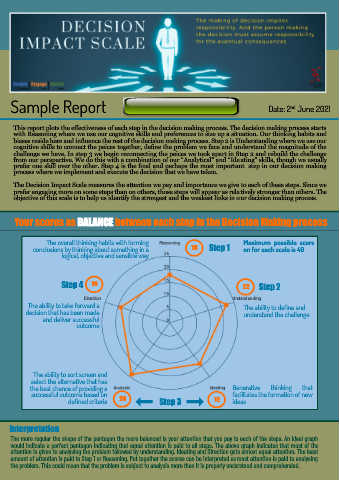
      This report plots the effectiveness of each step in the decision making process. The decision making process starts
      with Reasoning where we use our cognitive skills and preferences to size up a situation. Our thinking habits and
      biases reside here and influence the rest of the decision making process. Step 2 is Understanding where we use our
      cognitive skills to connect the peices together, define the problem we face and understand the magnitude of the
      challenge we have. In step 3 we begin reconnecting the peices we took apart in Step 2 and rebuild the challenge
      from our perspective. We do this with a combination of our “Analytical” and “Ideating” skills, though we usually
      prefer one skill over the other. Step 4 is the final and perhaps the most important step in our decision making
      process where we implement and execute the decision that we have taken.

      The Decision Impact Scale measures the attention we pay and importance we give to each of these steps. Since we
      prefer engaging more on some steps than on others, those steps will appear as relatively stronger than others. The
      objective of this scale is to help us identify the strongest and the weakest links in our decision making process.


      Your scores as BALANCE between each step in the Decision Making process


                 The overall thinking habits with forming                             Maximum possible score
            conclusions by thinking about something in a            18    Step 1      on for each scale is 40
                      logical, objective and sensible way


                      Step 4     19                                                   22    Step 2


          The ability to take forward a                                               The ability to define and
          decision that has been made                                                 understand the challenge
                and deliver successful
                           outcome


            The ability to sort screen and
            select the alternative that has
           the best chance of providing a                                         Generative    thinking   that
            successful outcome based on                                           facilitates the formation of new
                         defined criteria  24            Step 3             19    ideas


    Interpretation
    The more regular the shape of the pentagon the more balanced is your attention that you pay to each of the steps. An ideal graph
    would indicate a perfect pentagon indicating that equal attention is paid to all steps. The above graph indicates that most of the
    attention is given to analysing the problem followed by understanding. Ideating and Direction gets almost equal attention. The least
    amount of attention is paid to Step 1 or Reasoning. Put together the scores can be interpreted as most attention is paid to analysing
    the problem. This could mean that the problem is subject to analysis more than it is properly understood and comprehended.

