


Page 1 - Cognitive_Style_Index_Report_Sample_Report
P. 1
Sample Report                                                                   Date: 3 June, 2021
                                                                                                 rd


           Activities like thinking, learning, problem solving, and decision making are cognitive in nature and produce a
           dramatic impact on productivity, performance and potential for growth. The Cognitive Style Inventory
           provides a basis for identifying the patterns of behavior that typify people’s approaches to these critical
           activities. The instrument identifies cognitive styles that imply preffered and consistent patterns of responses
           that are both habitual and unconscious as well as deliberate


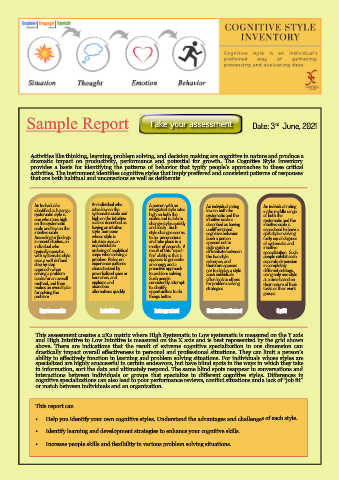
             An Individual is    An Individual who   A person with an    An individual rating  An individual rating
             identified as having a  rates low on the  integrated style rates  low on both the  in the middle range
             systematic style is  systematic scale and  high on both the  systematic and the  of both the
             one who rates high  high on the intuitive  scales and is able to  intuitive scale is  systematic and the
             on the systematic   scale is described as  change styles quickly  described as having  intuitive scale is
             scale and low on the  having an intutive  and easily . Such  undiffrentiated    considered to have a
             intuitive scale.    style. Someone      style changes seems  cognitive behavior.  split style involving
             According to findings  whose style is   to be unconscious   Such a person       fairly equal degrees
             in recent studies, an  intuitive uses an  and take place in a  appears not to   of systematic and
             individual who      unpredictable       matter of seconds . A  distinguish or   intuitive
             typically operates  ordering of analytical  result of this “rapid -  diffrentiate between  specialization . Such
             with systematic style  steps when solving a  fire” ability is that it  the two style  people exhibit each
             uses a well defined  problem. Relies on  appears to generate  extremes, and     separate dimension
             step by step        experience patterns  an energy and a    therefore appears   in completely
             approach when       characterized by    proactive approach  not to display a style .  different settings,
             solving a problem.  unverbalized cues or  to problem solving.  Such individuals  using only one style
             Looks for an overall  haunches, and     Such people         often look to others  at a time based on
             method, and then    explores and        consistently attempt  for problem solving  their nature of their
             makes an overall plan  abandons         to identify         strategies.         tasks or their work
             for solving the     alternatives quickly  opportunities to do                   groups.
             problem                                 things better.


               Systematic           Intuitive          Integrated        Undiffrentiated          Split


             This assessment creates a 2X2 matrix where High Systematic to Low systematic is measured on the Y axis
             and High Intuitive to Low Intuitive is measured on the X axis and is best represented by the grid shown
             above. There are indications that the result of extreme cognitive specialization in one dimension can
             drastically impact overall effectiveness in personal and professional situations. They can limit a person’s
             ability to effectively function in learning and problem solving situations. For individuals whose styles are
             specialized are highly scuccessful in certain endeavors, but have blind spots in the ways in which they take
             in information, sort the data and ultimately respond. The same blind spots reappear in conversations and
             interactions between individuals or groups that specialize in different cognitive styles. Differences in
             cognitive specializations can also lead to poor performance reviews, conflict situations and a lack of “job fit”
             or match between individuals and an organization.


             This report can

             •   Help you identify your own cognitive styles. Understand the advantages and challenges of each style.

             •   Identify learning and development strategies to enhance your cognitive skills.

             •   Increase people skills and flexibility in various problem solving situations.

