


Page 1 - Tolerance_to_Ambiguity_Scale_Sample_Report
P. 1
Sample Report                                                                             Date: 2 June 2021
                                                                                                      nd


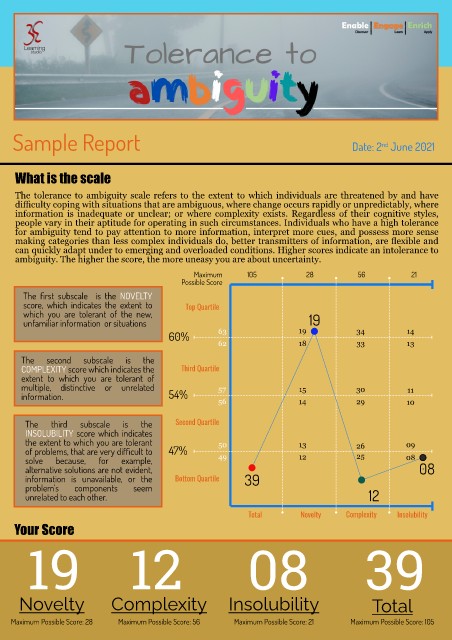
     What is the scale


     The tolerance to ambiguity scale refers to the extent to which individuals are threatened by and have
     difficulty coping with situations that are ambiguous, where change occurs rapidly or unpredictably, where
     information is inadequate or unclear; or where complexity exists. Regardless of their cognitive styles,
     people vary in their aptitude for operating in such circumstances. Individuals who have a high tolerance
     for ambiguity tend to pay attention to more information, interpret more cues, and possess more sense
     making categories than less complex individuals do, better transmitters of information, are flexible and
     can quickly adapt under to emerging and overloaded conditions. Higher scores indicate an intolerance to
     ambiguity. The higher the score, the more uneasy you are about uncertainty.
                                                    Maximum       105             28           56            21
                                                 Possible Score
       The first subscale is the NOVELTY
       score, which indicates the extent to       Top Quartile
       which you are tolerant of the new,
       unfamiliar information or situations                                       19
                                             60%          63                    19             34           14
                                                          62                    18             33           13
       The   second    subscale   is   the
       COMPLEXITY score which indicates the      Third Quartile
       extent to which you are tolerant of
       multiple,  distinctive  or  unrelated              57                    15             30           11
       information.                          54%
                                                          56                    14             29           10

        The   third   subscale   is   the      Second Quartile
        INSOLUBILITY score which indicates
        the extent to which you are tolerant               50                   13             26           09
        of problems, that are very difficult to  47%
        solve   because,   for   example,                  49                   12             25           08
        alternative solutions are not evident,                                                                 08
        information is unavailable, or the     Bottom Quartile   39
        problem's    components     seem
        unrelated to each other.                                                                  12

                                                                  Total         Novelty     Complexity    Insolubility
     Your Score
        19 12                                                     08                             39


      Novelty                 Complexity                     Insolubility                          Total

    Maximum Possible Score: 28  Maximum Possible Score: 56     Maximum Possible Score: 21    Maximum Possible Score: 105

