


Page 1 - Interpersonal Needs Inventory Sample Report
P. 1
Sample Report
                        Understanding your Intepersonal Orientation.


                                           No human wants to live in isolation and they want to interact and share
     The need for Inclusion                their  social  craving  among  other  people  be  it  in  their  workplace,
     relates to forming new                personal lives or any other social settings.
     relationships and associating
     with people and determines            This tool focuses on how you are oriented to interpersonal relations. It
     the extent of contact and             is a measure of your interpersonal needs and not a test of your abilities.
     prominence that a person              It identifies how you tend to behave towards others and how you want
     seeks. It is about                    them to behave towards you. This report will help you understand how
     recognition, belonging,               you  handle  interpersonal  relationships,  your  own  social  needs,  how
     participation, contact with           others perceive you and how you see them.
     others, and how you relate            This instrument is based on the model that identifies six interpersonal
     to groups. Descriptors                needs  under three broad categories - Inclusion, Affection and Control
     include: Belonging;
     Recognition; Involvement;              1. The need for interaction - Belonging & Recognition - INCLUSION
     Distinction; Participation.            2. The need for relationship - Affiliation & Reach out - AFFECTION
                                            3. The need for power - Power & Influence - CONTROL


                                            This  assessment  also  indicates  your  preferences  in  regard  to  two
     The need for Control                   distinct  aspects  of  each  of  these  need  areas.  Expressed  and  wanted
     indicates how much influence           behaviours    operate    dynamically    between     individuals.   How
     and responsibility you want to         individuals respond to expressed behaviour from others will depend
     cast around yourself and how           on  how  much  they  want  that  type  of  behaviour  or  are  prepared  to
     much you want others to lead           accept and tolerate.
     and influence you. Control is
     about both your one - to - one
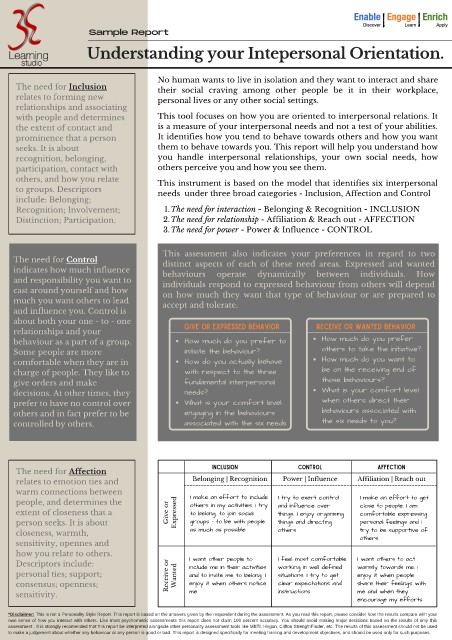
     relationships and your                       Give or Expressed behavior        receive or wanted behavior
     behaviour as a part of a group.              How much do you prefer to           How much do you prefer
     Some people are more                         initiate the behaviour?             others to take the initiative?
     comfortable when they are in                 How do you actually behave          How much do you want to
     charge of people. They like to               with respect to the three           be on the receiving end of
     give orders and make                         fundamental interpersonal           those behaviours?
     decisions. At other times, they              needs?                              What is your comfort level
     prefer to have no control over               What is your comfort level          when others direct their
     others and in fact prefer to be              engaging in the behaviours          behaviours associated with
     controlled by others.                        associated with the six needs       the six needs to you?


     The need for Affection                              Inclusion              control             Affection
     relates to emotion ties and                    Belonging | Recognition  Power | Influence  Affiliation | Reach out
     warm connections between                      I make an effort to include  I try to exert control  I make an effort to get
     people, and determines the                    others in my activities. I try  and influence over  close to people. I am
     extent of closeness that a              Give or  Expressed  to belong, to join social  things. I enjoy organising  comfortable expressing
     person seeks. It is about                     groups - to be with people  things and directing  personal feelings and I
     closeness, warmth,                            as much as possible    others                try to be supportive of
                                                                                                others
     sensitivity, opennes and
     how you relate to others.                     I want other people to  I feel most comfortable  I want others to act
     Descriptors include:                          include me in their activities  working in well defined  warmly towards me. I
     personal ties; support;                 Receive or  Wanted  and to invite me to belong. I  situations. I try to get  enjoy it when people
     consensus; openness;                          enjoy it when others notice  clear expectations and  share their feelings with
     sensitivity.                                  me                     instructions         me and when they
                                                                                               encourage my efforts

   *Disclaimer: This is not a Personality Style Report. This report is based on the answers given by the respondent during the assessment. As you read this report, please consider how the results compare with your
   own sense of how you interact with others. Like most psychometric assessments this report does not claim 100 percent accuracy. You should avoid making major decisions based on the results of only this
   assessment . It is strongly recomended that this report be interpreted alongside other personality assessment tools like MBTI, Hogan, Clifton StrengthFinder, etc. The results of this assessment should not be used
   to make a judgement about whether any behaviour or any person is good or bad. This report is designed specifically for meeting training and development objectives, and should be used only for such purposes.

